No Backstory, No Apology: Inside the Decision to Leave Our Villain Unexplained
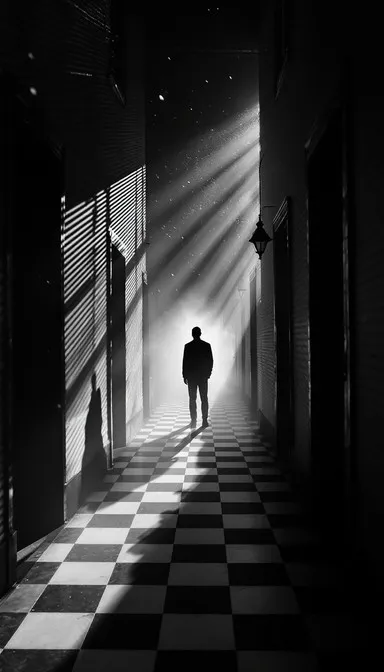
Photo: mysterious silhouetted figure shadow dark hallway film noir, via images.stockcake.com
There's a moment that happens at every festival Q&A for Kiss Me Kill Me. Someone in the back raises a hand and asks some version of the same question: So what made them that way?
And every time, the writers just smile.
"We get it," co-writer Dana Okafor told us last week, sitting in a Pasadena coffee shop that doubles as the film's unofficial writers' room. "Audiences have been conditioned to expect the villain's résumé. Trauma, motive, a sad flashback scored to piano. We made a deliberate choice not to do that. And some people find it genuinely unsettling."
That's putting it mildly. Since the film's premiere, the biggest debate online hasn't been about the twist — it's about the fact that the antagonist never gets explained. No confessional monologue. No tears-in-the-rain backstory. Just behavior, observed in real time, with all the terror that implies.
The Exposition Dump We All Grew Up On
Let's be honest about where we are. American moviegoers have spent fifteen years in the golden age of the villain origin story. Marvel made sympathetic antagonism a franchise formula. Prestige TV taught us that every monster has a wound. By now, the "here's why they're broken" monologue is practically a genre of its own.
"It's become a reflex," says co-writer Marcus Bell. "Character does something terrible, cut to a flashback, roll the sad music, and now the audience can file the threat away as understood. Safe. Contained. We wanted the opposite. We wanted the audience to never get comfortable."
That philosophy shaped the script from the first draft. Okafor and Bell wrote roughly forty pages of backstory for the antagonist — childhood, motivation, the whole tragic arc — and then did something unusual: they used it.
"All that work became the character's behavior," Okafor explains. "We knew exactly who they were and why. But the audience only sees the surface. The backstory exists. It's just not their business."
Why Ambiguity Is a Feature, Not a Bug
The writers have a theory about why unexplained villains hit harder now, not softer. When every motive is spelled out, menace becomes arithmetic — cause and effect, wound and weapon. Remove the equation, and you're left with something closer to how danger actually works in real life. You rarely get the full story. You just get the moment.
There's also a trust issue, and the writers are upfront about it. "Ambiguity only works if the rest of the film is precise," Bell says. "If your scenes are lazy, vagueness reads as sloppiness. If every scene is doing its job, the mystery reads as confidence. We sweat every frame so we could afford to leave one door locked."
Test screenings backed them up. Early audiences, Bell admits, pushed hard for explanation — one preview even requested a motive scene in the third act. The filmmakers shot a version. Then they screened both cuts back to back.
"The explained version was fine," Okafor says. "The unexplained version made people argue in the parking lot. You don't get parking-lot arguments from tidy movies. We kept the argument."
The Company They're Keeping
Kiss Me Kill Me isn't alone in trusting its audience. Recent indie genre fare has quietly mounted a counteroffensive against the exposition dump. Think of the recent wave of restrained home-invasion thrillers where the intruder's motives stay offscreen entirely, or the acclaimed cabin-in-the-woods picture that never once explains what's out there. Even bigger-budget work has flirted with the approach — the most memorable horror villain of the last few years barely speaks, let monologue.
What unites these films is a bet: that the viewer's imagination is a better special effect than anything you can shoot. Fill in the blanks yourself, and the blanks become personal. Your villain is scarier than our villain, because yours is built from your own fears.
"Hitchcock figured this out eighty years ago," Bell laughs. "The bomb under the table. You don't need to know who put it there. You need to watch people talk near it."
What the Audience Owes the Film
The writers are careful not to frame the choice as withholding — they see it as an invitation. The post-screening conversations, the Reddit threads, the couple in the parking garage still debating motive on the drive home: that's the ending they wrote for, even if it's not on screen.
"A monologue closes the case," Okafor says. "A silence opens it. We'd rather send you home with the open one."
So when you catch Kiss Me Kill Me — whether in theaters during the limited run or when it hits streaming next month — resist the urge to wait for the explanation that never comes. The lips stay sealed. That's not a flaw in the script.
That is the script.