The Two Inches We Never Crossed: How 'Kiss Me Kill Me' Turns the Near-Miss Into a Weapon

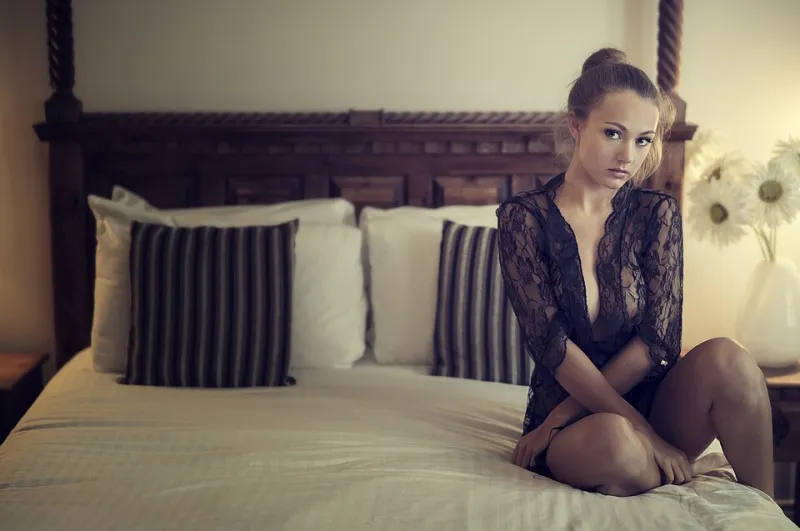
Photo: User:Bluemoose, CC BY-SA 3.0, via Wikimedia Commons
Everybody buys a ticket for the kiss. That's fine. The poster promises it, the title says it twice, and by the time the lights go down you have already decided what the payoff looks like in your head.
Here's the thing we learned in the edit bay: the payoff is not the scariest part of this movie. The near-miss is. The two inches of air between two people who both know better — that's the special effect. We didn't need a bigger budget for it. We needed a willingness to keep cutting away.
This is the spoiler-light version of that argument, because we're not going to walk you through the ending. We're going to walk you through the craft.
The lean that never lands
Watch any classic suspense sequence and you'll notice the violence almost never happens on the beat you're braced for. Hitchcock figured this out a century ago and every thriller since has been borrowing the trick with interest.
We applied it to a kiss.
Our leads lean in, and something interrupts. A car door. A phone lighting up face-down on the table. A question that shouldn't be asked yet. The interruption is never random — it's always the plot clearing its throat — but that's not why it works. It works because your body has already committed. Your heart rate went up on the lean. The cut takes that rise and drops it off a cliff, and then your brain files the whole thing under danger instead of romance. Which is exactly where we want it.
Blocking: put furniture between them
Our director has a rule that sounds like a joke until you watch the film twice: nobody in this movie gets a clean line of sight to anybody they want.
So we block. A kitchen counter. A half-open door. The back of a diner booth. A car window with the reflection doing more acting than the actors. Sometimes the obstacle is another person, standing exactly where they shouldn't be standing, holding a coffee they never drink from.
When you put something physical in the way, the audience starts doing math. Can they see each other? Is she leaning or is that the angle? If he steps left, does this happen? That math is the movie. It's the cheapest suspense generator ever invented and it costs one table.
We also shot most of these near-misses tight — shoulders, jawlines, hands. Wide shots show you the whole room and let you relax. Close-ups make the room feel like it has a ceiling pressing down on it. Our camera operator called them "breathing shots," because the only thing moving in frame is somebody's chest.
Editing: cut on the inhale
This is the part that makes or breaks the whole gag.
If you cut on the movement, you get a music video. If you cut on the moment of contact, you get a romance. We cut on the inhale — that little pull of breath right before somebody commits to something they'll regret. It's a fraction of a beat earlier than the audience expects, and that early cut feels like a hand on your shoulder.
We tested it. Rough cut, assembled in a spare room with a laptop and a fan pointed at the hard drive, we ran the near-miss sequence for eleven people who had no idea what the movie was. Nine of them said some version of "I couldn't breathe." Two of them said "why did you keep doing that to me." Both answers were correct. Both answers were the review we wanted on the poster.
The sound of almost
Scoring a near-miss is counterintuitive. The instinct is to swell. We did the opposite.
When our leads get close, the score gets quieter, the room tone gets louder, and we let the practical sounds take over — the hum of a refrigerator, a neighbor's TV through a wall, a shoe scuffing on linoleum. Those sounds say this is a real place and something is about to happen in it. A violin says this is a movie.
There's a moment in the second act where the only audio is a radiator ticking. Nobody in a test screening mentioned the radiator. Everybody in a test screening leaned forward during it.
Why withholding beats payoff
Here's the honest editorial take, and you can disagree with us in the replies.
A kiss on screen is a closed loop. It resolves. It answers the question the movie spent an hour asking, and once it's answered, the tension has to rebuild from scratch. A near-miss, on the other hand, is a loan. It keeps the audience in debt to the story.
And there's a nastier layer, which is that in a thriller, wanting something is dangerous. Every time our characters get close, the audience's own desire becomes evidence. You wanted this. Look what it costs. That's not a trick you can pull with the kiss itself. The kiss is a reward. The almost-kiss is a receipt.
What to watch for the second time
If you've already seen it, go back and count the interrupted moments. Keep a tally. We've had fans report anywhere from six to twelve depending on how generous they're being with the definition, and the argument over what counts is genuinely one of our favorite things happening in the comments.
Then watch where the camera is during each one. Notice how often somebody's hand is in frame doing nothing. Notice how many of these scenes end with a person alone in a room they didn't want to be in.
That's the effect. No CG, no rig, no budget line. Just a lean, a cut, and the courage to stop two inches short.
The kiss is what you came for. The almost is what keeps you up afterward.